
Heavy equipment insurance: the line between an auto and mobile equipment
Two standard forms decide which policy answers for a machine, and they were drafted to interlock. The general liability form and the business auto form define "auto" and "mobile equipment" in the same words, and the switch between them is the motor vehicle law of the state where the unit is licensed or principally garaged, not what the machine looks like. Then a third question arrives that neither answer covers: the same excavator on a trailer on a public road. This page reads both forms and the federal rules that reach the trip.
Tow truck insurance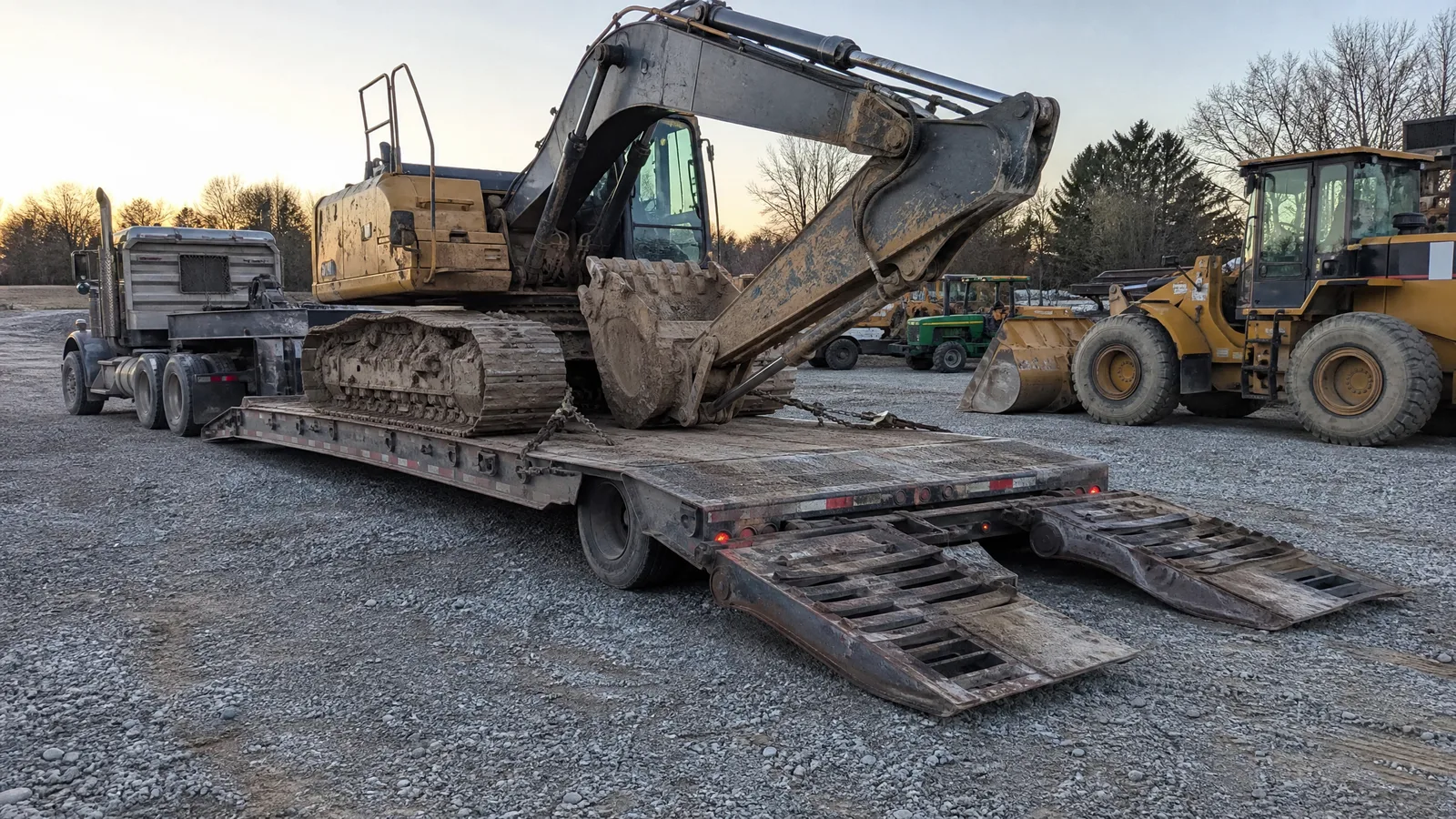
The one line that decides everything: auto, or mobile equipment
An operator whose machines are the business runs into the same wall every time a new unit arrives: nobody can tell them which policy the thing belongs on. The answer is written down, in two places, in matching language, and once you have read both the rest of the page follows from it.
The general liability side is the ISO Commercial General Liability Coverage Form, edition CG 00 01 04 13, read here from a specimen the County of Sonoma publishes. Its definition of "auto" is a land motor vehicle, trailer or semitrailer designed for travel on public roads including any attached machinery or equipment, or any other land vehicle that is subject to a compulsory or financial responsibility law or other motor vehicle insurance law where it is licensed or principally garaged. It ends with five words: auto does not include mobile equipment.
Mobile equipment then gets six paragraphs. Bulldozers, farm machinery, forklifts and other vehicles designed for use principally off public roads. Vehicles kept for use solely on or next to premises you own or rent. Vehicles that travel on crawler treads. Vehicles, self-propelled or not, kept primarily to give mobility to permanently mounted power cranes, shovels, loaders, diggers or drills, or to road construction or resurfacing equipment such as graders, scrapers or rollers. Two further paragraphs cover non-self-propelled carriers for permanently attached equipment: air compressors, pumps and generators including spraying, welding, building cleaning, geophysical exploration, lighting and well servicing gear, and cherry pickers used to raise or lower workers. A last paragraph sweeps in vehicles kept primarily for purposes other than carrying persons or cargo.
Then the definition takes two things back. First, self-propelled vehicles carrying certain permanently attached equipment "are not 'mobile equipment' but will be considered 'autos'": gear designed primarily for snow removal, road maintenance other than construction or resurfacing, or street cleaning; cherry pickers mounted on an automobile or truck chassis; and the compressors, pumps and generators from the list above once they sit on a self-propelled chassis. Second, and this is the sentence that decides most arguments: mobile equipment does not include any land vehicle subject to a compulsory or financial responsibility law or other motor vehicle insurance law where it is licensed or principally garaged, and such land vehicles "are considered 'autos'."
Now put the business auto form next to it. Its own definitions section says the same thing from the other direction: an auto is a land motor vehicle designed for travel on public roads or any other land vehicle subject to a motor vehicle insurance law where it is licensed or principally garaged, an auto does not include mobile equipment, and mobile equipment does not include land vehicles subject to such a law because those are considered autos. The two forms are not competing. They are one definition split across two policies, and the state registration statute is the switch that throws a machine from one to the other.
The practical consequence is the thing to carry away. The same articulated boom truck can be mobile equipment in one state and an auto in the next with nothing changed but the plate. On the auto policy, the entry that catches the units that flip is symbol 19, mobile equipment subject to a compulsory or financial responsibility law, and how symbols work at all is the subject of the fleet insurance page. If your machines are registered in more than one state, that is a question to raise before anything is bound, not at renewal. The Texas pages show how much of this vertical's regulation is written at the state level rather than the federal one.
Excavator insurance: the machine that is almost never an auto
An excavator sits in the first paragraph of the mobile equipment definition twice over. It is designed for use principally off public roads, and if it is a tracked machine it also travels on crawler treads. States do not generally register it for highway use, so the sentence that pushes registered land vehicles back into "auto" does not reach it. For most operators most of the time, the excavator is mobile equipment, its liability sits with the general liability policy, and the auto policy never sees it except while it is riding on something.
The exception worth knowing is the wheeled machine that is plated. A rubber-tired excavator or a wheel loader that a state licenses for road travel is a land vehicle subject to a motor vehicle insurance law, which under both forms makes it an auto. That is not a paperwork detail. It moves the machine's liability from one policy to the other, and if nobody told the auto carrier the unit exists, it may sit on neither.
Damage to the machine itself is a third policy again, and it is worth being precise about why. Property coverage written on the standard commercial forms answers for property at a described place, which is the wrong shape for iron that sleeps somewhere different every week. The line written for property that does not stay put is inland marine, and IRMI describes it as reaching property in transit over land and movable property that may not remain at a fixed location, with many forms covering without regard to where the property is. That in-transit clause is the reason this matters here: it is the same policy that answers whether the machine is damaged sitting in the hole or coming off the trailer, and no auto policy makes a promise about the machine it is carrying.
We are not going to print an exclusion list for that policy. There is no single published form for it the way there is for general liability, and none was read for this page, so anything we listed would be somebody's summary of somebody's form. Ask the agent to open the form being quoted and point at three things: how each machine is listed and valued, what the form says about property in transit, and what it says about machines you rent from a yard. Those three answers are most of what separates one of these policies from another.
One more excavator surprise, and it belongs to OSHA rather than to insurance. It is in the next section, because it is the sentence that separates an excavator from a crane.
Crane insurance: the machine a federal safety rule actually reaches
Cranes are the one category in this page where a federal standard names the machine and tells the employer what to do about the person in the seat. That standard is 29 CFR 1926 subpart CC, cranes and derricks in construction, and its scope section is one sentence: the standard applies to power-operated equipment, when used in construction, that can hoist, lower and horizontally move a suspended load. Articulating cranes, crawler cranes, tower cranes and mobile cranes are named in the list of what is included.
Read "when used in construction" as a real limit. Subpart CC lives in the construction part of the OSHA regulations. A crane doing something other than construction work is reached by other standards, and those were not read for this page.
The scope section also lists what falls outside, and this is where the excavator question gets its answer. 1926.1400(c)(2) excludes power shovels, excavators, wheel loaders, backhoes, loader backhoes and track loaders, and then adds a second sentence: this machinery is also excluded when used with chains, slings or other rigging to lift suspended loads. An excavator picking a length of pipe on a sling is doing crane work by any plain description of the words, and subpart CC still does not apply to it. Other parts of the OSHA regulations may; this page does not read them and does not tell you the lift is unregulated.
Other categories the scope section pushes out are worth knowing because operators own them: machinery converted or adapted for a non-hoisting use, aerial lifts and self-propelled elevating work platforms, forklifts except when configured to hoist and move a suspended load, dedicated drilling rigs, digger derricks on pole line work under stated conditions, and automotive wreckers and tow trucks clearing wrecks. That last one is why a recovery unit lifting a rolled truck is a different regulatory animal, and the tow truck insurance page reads the rules that do reach it.
The operator. Where subpart CC does apply, 29 CFR 1926.1427(a) is direct: the employer must ensure that each operator is trained, certified or licensed, and evaluated in accordance with that section before operating any covered equipment. The section gives three routes to the certification half. A state or local government licensing program, where one exists and its written and practical assessments meet the criteria, and the employer must use it where it is available. Certification by a testing organization accredited by a nationally recognized accrediting agency, which travels with the operator between employers and runs five years. Or an employer-run program using tests developed or approved by an accredited testing organization, audited within three months of starting and every three years after, which does not travel and also runs five years. Separately, 1926.1427(f) requires the employer to evaluate the operator and document that the person has the skills, the knowledge, and the ability to recognize and avert risk needed to run the machine safely.
Note what that is and is not. It is an employer duty under a safety standard, and it produces documents. No published source says a carrier requires them, prices them, or declines without them. What is true either way is that the paperwork exists whether or not anyone asks for it, and that "what does the carrier want to see about the people who run these machines" is a fair question to put to an agent early rather than during an application.
Small machines get a shorter list. 29 CFR 1926.1441 covers employers using equipment with a maximum rated hoisting or lifting capacity of 2,000 pounds or less, and paragraph (a) enumerates the subpart CC provisions that still apply to it. 1926.1427 is not one of them. The section imposes its own requirements instead, including its own operator and signal person training, which this page does not summarize because the text of that paragraph was not read.
The plated boom truck. A crane mounted on a registered truck chassis is the case where the auto and mobile equipment line and the crane rules meet, and the general liability form has a specific answer. Its aircraft, auto or watercraft exclusion would ordinarily knock out anything arising from the use of an auto the insured owns or operates. But the exclusion carves out injury or damage arising from the operation of machinery or equipment that is attached to, or part of, a land vehicle that would have qualified as mobile equipment if it were not subject to a compulsory or financial responsibility law where it is licensed or principally garaged. In plain terms: the chassis became an auto because the state plates it, and the boom's own operation is handed back to the general liability policy anyway. That is a carve-out inside an exclusion, read against the rest of the form and against the facts of the claim, so treat it as the reason to ask the question rather than as an answer to it.
The machine on the trailer, and what hauling it makes you
Here is the question the rest of the internet leaves alone. Your excavator is mobile equipment on a job site. It is 40,000 pounds of somebody's problem when it is on a lowboy in the right lane of an interstate. Which policy is that, and does moving it turn you into something you were not this morning?
The forms answer the first half cleanly. The general liability form carries an exclusion headed Mobile Equipment, and its first paragraph excludes injury and damage arising out of the transportation of mobile equipment by an auto owned or operated by or rented or loaned to any insured. The general liability policy says, in so many words, that the moment the machine goes up the ramp it is not this policy's problem. The business auto form then picks it up by name: wherever that form provides liability coverage, mobile equipment while it is being carried or towed by a covered auto is itself a covered auto for that coverage. Two forms, one handoff, no gap, and it works only if the truck and trailer are actually covered autos on a policy that is in force.
Notice what neither form promised. Both sentences are about liability, meaning harm to other people and their property. Nothing there says a word about damage to your machine while it is riding. That question goes back to the property side, which is why the in-transit clause described in the excavator section above is the thing to have the agent point at.
Now the half nobody answers. Operators assume the federal motor carrier rules are about hauling freight for money, so moving their own iron cannot be covered by them. Read the applicability sentence. 49 CFR 390.3(a) says the rules apply to all employers, employees, and commercial motor vehicles that transport property or passengers in interstate commerce. There is no for-hire condition in that sentence. The exceptions in paragraph (f) are specific categories, and the one closest to this situation, occasional transportation of personal property by an individual not for compensation, is not a description of a company moving its own working assets between jobs.
49 CFR 390.5 supplies the words. A motor carrier is "a for-hire motor carrier or a private motor carrier." A private motor carrier is "a person who provides transportation of property or passengers, by commercial motor vehicle, and is not a for-hire motor carrier." A for-hire motor carrier is one transporting goods or passengers for compensation. Nobody is paying you, so you are not the second one. That places you in the first one, by definition, if the other two conditions are met. The registration rule at 49 CFR 390.201(b)(1) makes the point out loud: the persons who must file Form MCSA-1 are "each motor carrier (including a private motor carrier, an exempt for-hire motor carrier, a non-exempt for-hire motor carrier, ...)". Private carriers are named first.
The two conditions are facts about your operation rather than about your machines. Does the combination meet the commercial motor vehicle definition in 390.5, whose first prong is a gross vehicle weight rating or gross combination weight rating of 10,001 pounds or more, whichever is greater? A one-ton pickup pulling a loaded equipment trailer usually clears that without anybody noticing. And is the movement interstate commerce as that section defines it, which includes a trip wholly inside one state that is part of transportation originating or terminating outside it? Those two answers belong to the FMCSA, and it is a much better conversation to have before the first out-of-state job than after a roadside inspection.
Driver licensing is a separate rulebook with separate numbers. 49 CFR 383.5 defines its own commercial motor vehicle for licensing: Group A is a combination with a gross combination weight rating or weight of 26,001 pounds or more including a towed unit rated or weighing more than 10,000 pounds; Group B is a straight vehicle at 26,001 pounds or more; Group C catches 16-or-more-passenger vehicles and placarded hazardous materials. Part 383 uses a broader idea of commerce than Part 390 does, and the state that issues the license is what makes it operative for a given driver, so confirm it there. The number that catches equipment haulers is the trailer one: a tractor and a lowboy carrying a mid-size machine goes over 26,001 pounds combined with a trailer above 10,000 pounds long before anyone thinks of themselves as a trucking company.
The good news, and it is real. The federal liability minimum does not follow you into this. 49 CFR 387.3(a) applies that subpart to for-hire motor carriers transporting property in interstate or foreign commerce, with an extension for hazardous materials and an exception below 10,001 pounds GVWR, and the schedule of amounts in 49 CFR 387.9 hangs off that applicability. Moving your own machines to your own jobs is not carriage for compensation, so the federal schedule does not attach. The tow truck insurance page reads that subpart in full for the operators it does reach. What replaces it in practice is contractual: a project owner's insurance requirements, a general contractor's certificate demands, an equipment lender's loss payee terms, and any state permit needed to move an oversize load. Those are usually the numbers that actually govern, and none of them is in the CFR.
Hauling other people's machines for money is a different business with different paperwork, including cargo coverage and operating authority. That is for-hire carriage of property and it is outside what this page covers.
Liability while the machine is working
The general liability form's aircraft, auto or watercraft exclusion is broad, and reading it is the fastest way to understand why the auto and mobile equipment line matters so much. It removes injury and damage arising out of the ownership, maintenance, use or entrustment to others of any auto owned or operated by or rented or loaned to any insured, says use includes operation and loading or unloading, and adds that it still applies where the claim is dressed up as negligent hiring, training, supervision or monitoring if the occurrence involved such an auto.
That is the whole reason the definition fight is worth having. If a machine is an auto, this exclusion reaches almost everything it does, and the auto policy has to be the one carrying it. If the machine is mobile equipment, the exclusion never engages and the general liability policy is doing the work. There is no third state, and there is no version where both answer for the same event just because you bought both.
Two carve-outs pull specific things back. The first is the plated-chassis rule described in the crane section: the operation of machinery attached to or part of a land vehicle that would have been mobile equipment but for a registration law. The second returns the operation of the compressors, pumps, generators, spraying, welding, building cleaning, geophysical exploration, lighting, well servicing gear, and the worker-raising cherry picker devices named in the mobile equipment definition. Both are exceptions inside an exclusion, which is the most fact-sensitive kind of policy language there is.
What to do with this, concretely. Write down every machine, and next to each one write whether the state where it is garaged registers it for highway use. That single column sorts the schedule into two policies. Then hand the list to an agent and ask which policy each row is on and what the declarations say about it. An operation running mixed units out of one yard has exactly the situation the covered auto symbols were built for, and the fleet insurance page walks through how those symbols are entered and what changes when a unit is bought mid-term. If your operation also runs road vehicles that carry other people's property or people, the transport types index has the page for each of them.
Rigging, and other people's property in your hands
The day the machine picks something that belongs to someone else, a different exclusion wakes up. The general liability form's Damage To Property exclusion lists categories of property that the policy does not cover damage to, and paragraph (4) is four words long in substance: personal property in the care, custody or control of the insured. Paragraph (5) sits next to it and removes that particular part of real property on which you or your contractors are performing operations, when the damage arises out of those operations.
Read that against what a lift actually is. A rooftop unit hanging off your hook, a transformer swinging over a pad, a modular section being set: for the length of the pick, that property is arguably in your care, custody or control, and the general liability policy has said it does not answer for damage to it. The exclusion is not absolute in application, courts have read the phrase both as physical possession and as a legal duty to look after the thing, and the form carries its own set of exceptions for short-term rented premises and for liability assumed under a sidetrack agreement. But the default the operator should assume is that the load is not covered by the policy covering everything around it.
The named answer is riggers liability. IRMI defines riggers liability insurance as covering a contractor's liability arising out of moving property and equipment belonging to others, giving the example of lifting air-conditioning units onto a roof with a crane, and notes the coverage is usually added back by endorsement because the care, custody or control exclusion took it away. It is not automatic and it is not included by default. If lifting other people's property is part of what you sell, this is a specific thing to ask for by name, along with what limit applies to a single pick and how the value of the load is determined.
The same structure appears elsewhere in this vertical, which is a useful way to see it. A wrecker hooks somebody else's vehicle and needs a coverage written for exactly that moment; the tow truck insurance page has that pair. The pattern is constant: general liability answers for what you do to the world, and property belonging to others that is temporarily in your hands is carved out and bought back on purpose.
Heavy equipment insurance cost: what the inputs actually are
This site publishes no premium figures and nothing below is a rate. These are the inputs that produce one, and they are worth reading because they tell you which questions an agent should be asking before a number appears.
Per machine. What it is and what it was designed for, since that is what decides whether it is an auto or mobile equipment and therefore which form is being priced at all. Where it is registered and principally garaged, because the law there is the switch. Its value, and how that value is set. Whether it is owned, financed, or rented from a yard, since a rental contract usually puts responsibility for the machine on you regardless of what your policy says.
Per operation. How much of the year the machines spend on public roads, and what pulls them. Whether the work is construction, which is what brings the crane standard into the picture for a crane. Whether the operation lifts, hauls, or stores property belonging to other people, which is a coverage question ahead of a rating one. Whether the operation crosses state lines, and therefore whether the federal safety rules and registration described above are in play. Where the machines sit overnight.
People and history. Operator experience on the specific machine class. Driving records for whoever moves the units on the road. Loss history. Whether the certification and evaluation records the crane standard makes an employer's duty exist and are current.
Every one of those inputs moves the number, and so does the carrier and the state. A quote that arrives without anyone asking where the machines are registered, how often they travel, or whether you pick other people's property has been priced on a list of assets rather than on your operation. Start from the overview if you are unsure which page describes your work, or from the transport types index.