
Tow truck insurance, one exposure at a time
A tow operation carries commercial auto liability for the truck, on-hook coverage for the vehicle behind it, garagekeepers for the vehicles on its lot, physical damage for the wrecker, and general liability for everything that happens off the road. Which of those the law requires depends on the regulator: the FMCSA for interstate for-hire work, the state permit agency for towing inside one state, and often a city or county on top.
A naming caution worth carrying into any quote conversation: one national carrier states that in Texas and Virginia the coverage it calls on-hook elsewhere is sold as garagekeepers legal liability, and what it calls garagekeepers elsewhere is called storage location there. That is one carrier describing its own forms rather than a statement about Texas law, but it means the word on your quote may not tell you which stage you are buying. Ask which stage, not which word.
The five coverages that follow a tow truck
Commercial auto liability. The truck itself, on the road, at fault. Every regulator that touches towing starts here, and the limit it demands is the number to know before anything else is priced.
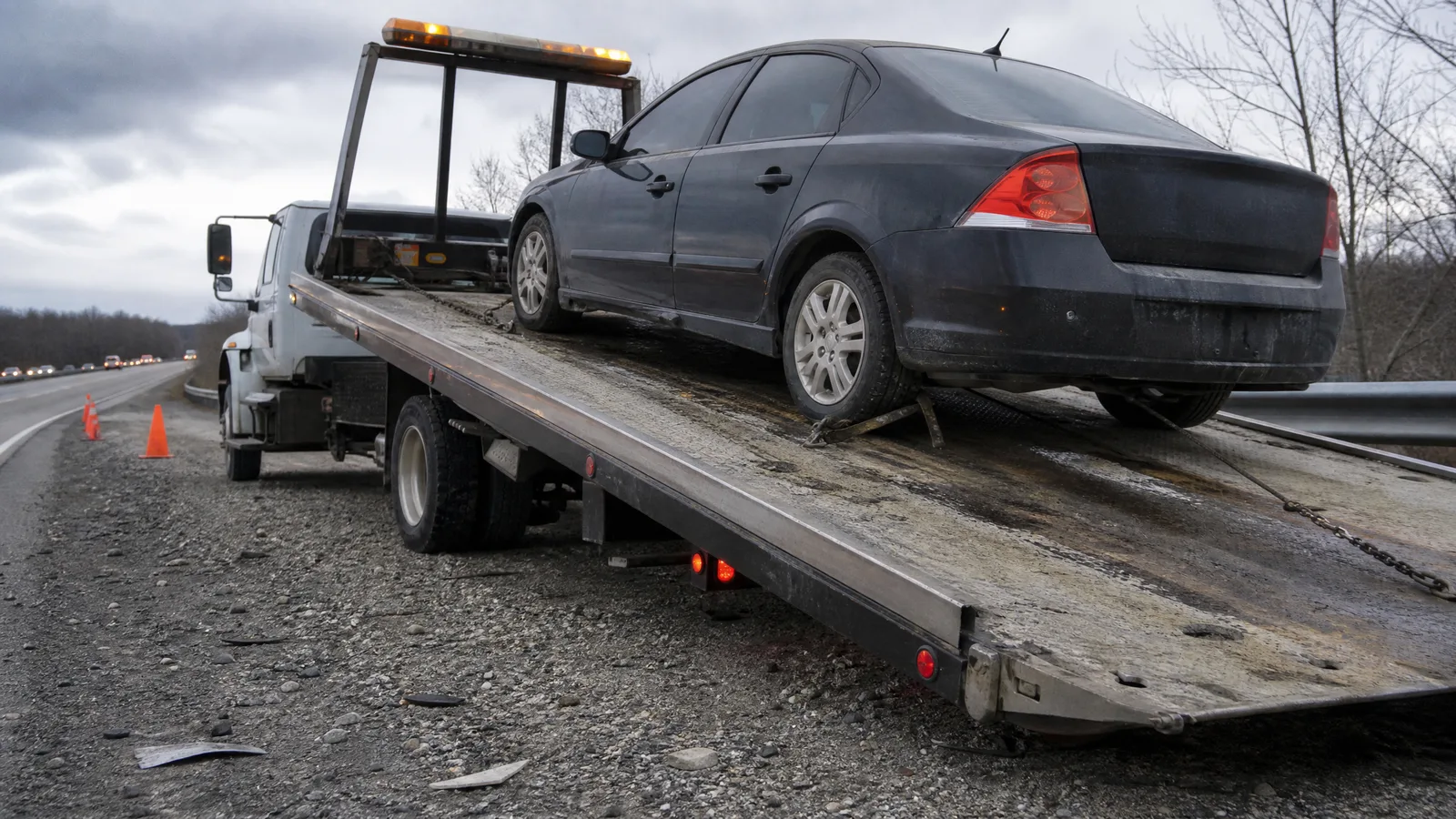
On-hook. The vehicle you are towing is someone else's property in your control, and a standard auto policy does not treat it as your cargo. On-hook coverage pays to repair or replace a vehicle you do not own that is damaged by collision, fire, theft, explosion, or vandalism while you are towing or hauling it, as one national carrier describes its own form (Progressive Commercial). The Texas permit rule names this exposure outright as "cargo or cargo on hook" coverage, which is a useful reminder that a state can require it by name.
Garagekeepers. Once the vehicle comes off the hook and onto your yard, the exposure changes forms. IRMI defines garagekeepers as coverage for liability arising from damage to a customer's auto left in the insured's care, with the basic form contingent on the insured being legally liable (IRMI); the extension that pays regardless of liability is what agents now call direct coverage (IRMI, garagekeepers extra legal liability). A hailstorm over a full impound lot is the case that decides which version you wanted.
Physical damage. Your own units. A heavy-duty wrecker or rotator is the most valuable thing the business owns, and a lender will require the coverage even when a regulator does not.
General liability. The release dispute at the yard window, the customer who trips at the gate, the sign that falls. None of it is an auto claim, and none of it is covered by the auto policy.
Three regulators can set your floor
Federal. The FMCSA's financial responsibility rules apply to for-hire motor carriers transporting property in interstate or foreign commerce, with an exception for vehicles rated under 10,001 pounds (49 CFR 387.3). For that class the schedule of limits requires $750,000 for nonhazardous property (49 CFR 387.9, as of 2026). A recovery operation that hauls wrecks across a state line for hire is inside this rule; a tow company that never leaves its home state is not.
State. This is where most tow operators actually find their requirement, and states write it in different places. Texas is the clearest example in the country: a tow truck may not perform a consent or nonconsent tow on a public roadway without a permit, each truck needs its own, and the statute itself states the liability and cargo insurance each of the three permit types must show (Texas Occupations Code Chapter 2308, Sections 2308.101 through 2308.105). The permit agency, the Texas Department of Licensing and Regulation, then fills in how the certificate is filed and what happens when coverage lapses. The full walk-through is our Texas tow truck insurance page.
Local. Towing is the one transport class where cities matter as much as states, because nonconsent work runs through municipal rotation lists and impound contracts. Texas law makes the mechanism explicit: a political subdivision may require registration of a tow truck that performs a nonconsent tow in its territory, whether or not the owner has a place of business there (Texas Occupations Code Section 2308.201). Those local programs commonly attach their own conditions, which is why the permit minimum and the coverage a working operator carries are rarely the same number.
What an agent who writes tow will ask
Tow is a specialty class, and operators know it: in Semrush US keyword data pulled in 2026, more people search for tow truck insurance brokers than for tow truck insurance itself. The questions a specialist asks are the questions that shape the quote. Which kind of towing you do, since police-directed incident work carries the highest exposure and, where a state sets one, the highest minimum. How many units you run and what each is worth. Whether you store vehicles, and if so how many and behind what fence. Which contracts you hold or want, because a rotation list or a motor club will have its own certificate requirements. Driver records, radius, and claims history. An agent who does not ask those questions is quoting a truck, not a tow business.
This site does not publish premium figures. Rates vary by carrier, state, permit type, fleet size, driver records, storage exposure, and loss history, and a number without those inputs would mislead more than it informs. Start with the operation types we cover if towing is only part of what you run.